Guides
Bedroom curtains: how to get the room properly dark
Plenty of bedrooms have opaque fabric and still wake up bright. The fabric is rarely the problem — the light is coming in around it.
Where do you start when choosing bedroom curtains?
Start by asking how dark you actually need it. Someone who sleeps at night and gets up in the morning needs less than someone on night shifts sleeping through full sun. After that there are three decisions, in order: how opaque the fabric is, how the gaps around it get closed, and how you'll open and close it. The first two decide the darkness. The last decides whether you really use it every day.
Does a bedroom always need blackout fabric?
Not always. Blackout is fabric that lets no light through the cloth at all — right for daytime sleepers, rooms with a streetlight or a lit sign outside, and small children's naps. Dim-out makes the room clearly darker without going fully dark: in the morning you can tell it's light, but nothing glares. Plenty of people who like waking with daylight prefer that level.
Colour tells you nothing about opacity. There are pale blackouts, and there are dark fabrics that light still passes through. For the levels in detail — including why sunscreen shouldn't be the only layer in a bedroom — see blackout or sunscreen fabric.
Opaque fabric and the room still isn't dark — where is the light getting in?
Once the fabric stops everything, whatever light is left comes through the gaps around it — and in a dark room a thin line of light is far more noticeable than it would be in a bright one. There are only a few places it gets in.
- The sides — a roller blind needs a little clearance between the fabric edge and the wall so it can run without scuffing. A curtain on a track cut to the width of the frame doesn't reach the wall either.
- The top — light gets between the roller and the wall, or between the track and the ceiling, then bounces off the ceiling across the whole room. This is the one people miss most.
- The bottom — a blind or curtain that stops at the sill leaks under the hem. Floor-length curtains have much less of this.
- The middle — where two panels of a centre-parting curtain only just meet instead of overlapping, there's a line of light at the join.
Inside the frame or outside it — which is darker?
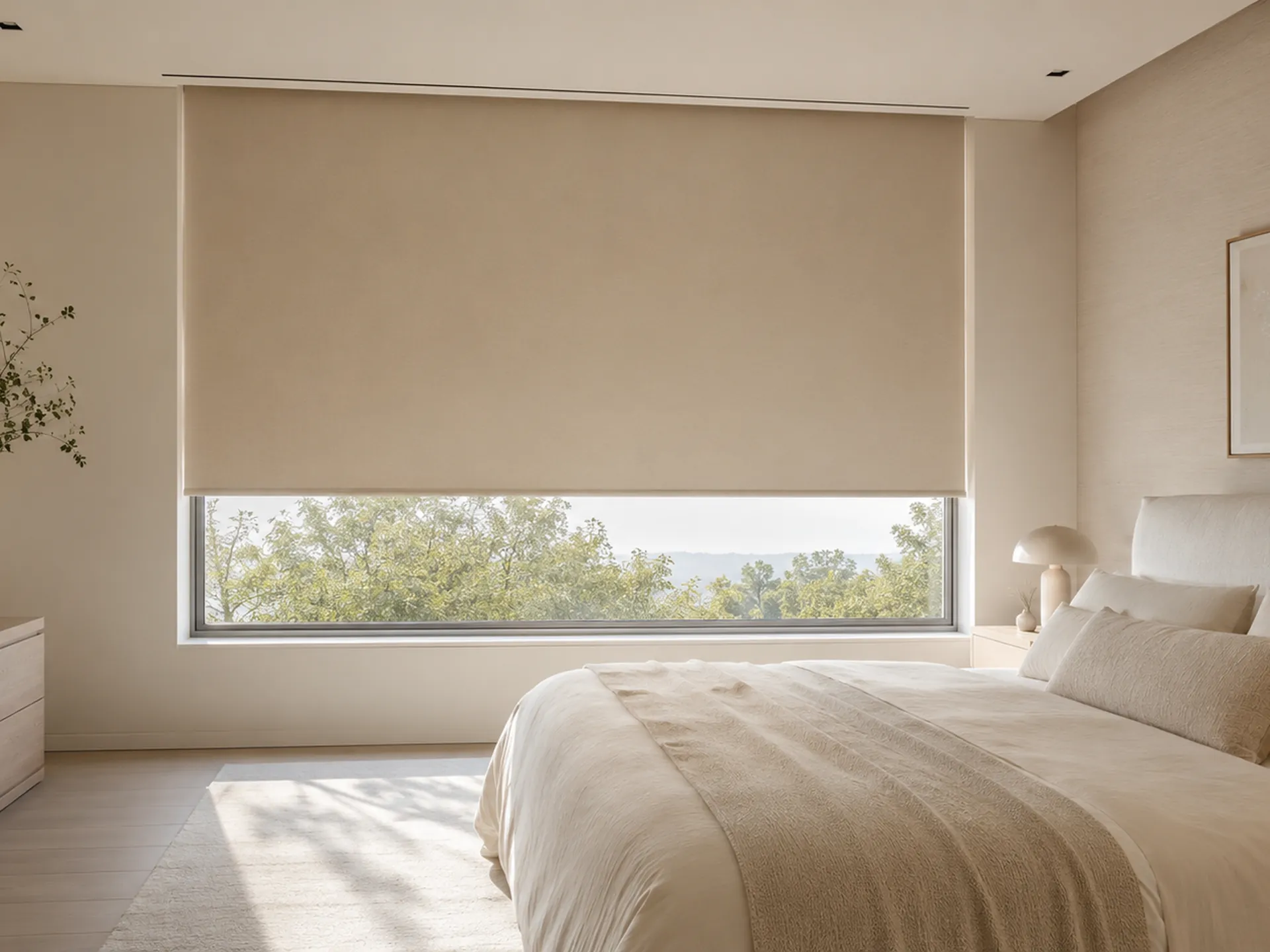
Outside is darker in almost every case. Fitting inside the reveal looks neat and doesn't intrude on the room, but the fabric always has to be narrower than the opening, so light comes down both edges. Mounted over the frame, the fabric runs past the window and overlaps the wall, so light has to get round the edge before it enters. The cost is a little more wall taken up around the window.
The same goes for curtains: a track that runs past the window on both sides and sits above the frame closes off more light than one cut to the frame. For the top, homes with a pelmet box or a curtain recess in the ceiling have an advantage — the heading is hidden inside and light can't reach the ceiling. That is ceiling work that has to be planned during the fit-out. If darkness is the aim, say so at the measure, because the mounting position and the overlap change with it. The basics of measuring are in how to measure your own windows.
For a really dark bedroom: roller blind, curtain, or both?
| Setup | Darkness you usually get | Where light still gets in | Suits |
|---|---|---|---|
| Blackout roller, inside the frame | Much darker, with lines of light at the edges | Both sides, and the top | Small rooms, a bed against the window, people relaxed about morning light |
| Blackout roller, outside the frame | Clearly darker than the first | The top, and a little at the sides | Rooms that want a flat, compact look |
| Opaque curtain on a track wider than the window | Good darkness, sides well covered | The top if there's no pelmet, and the centre join | Rooms that want the softness of fabric and have wall beside the window for the stack |
| Blackout roller inside, curtain over it | The darkest of these options | Very little — the curtain covers the roller's edges | Daytime sleepers, rooms facing a streetlight |
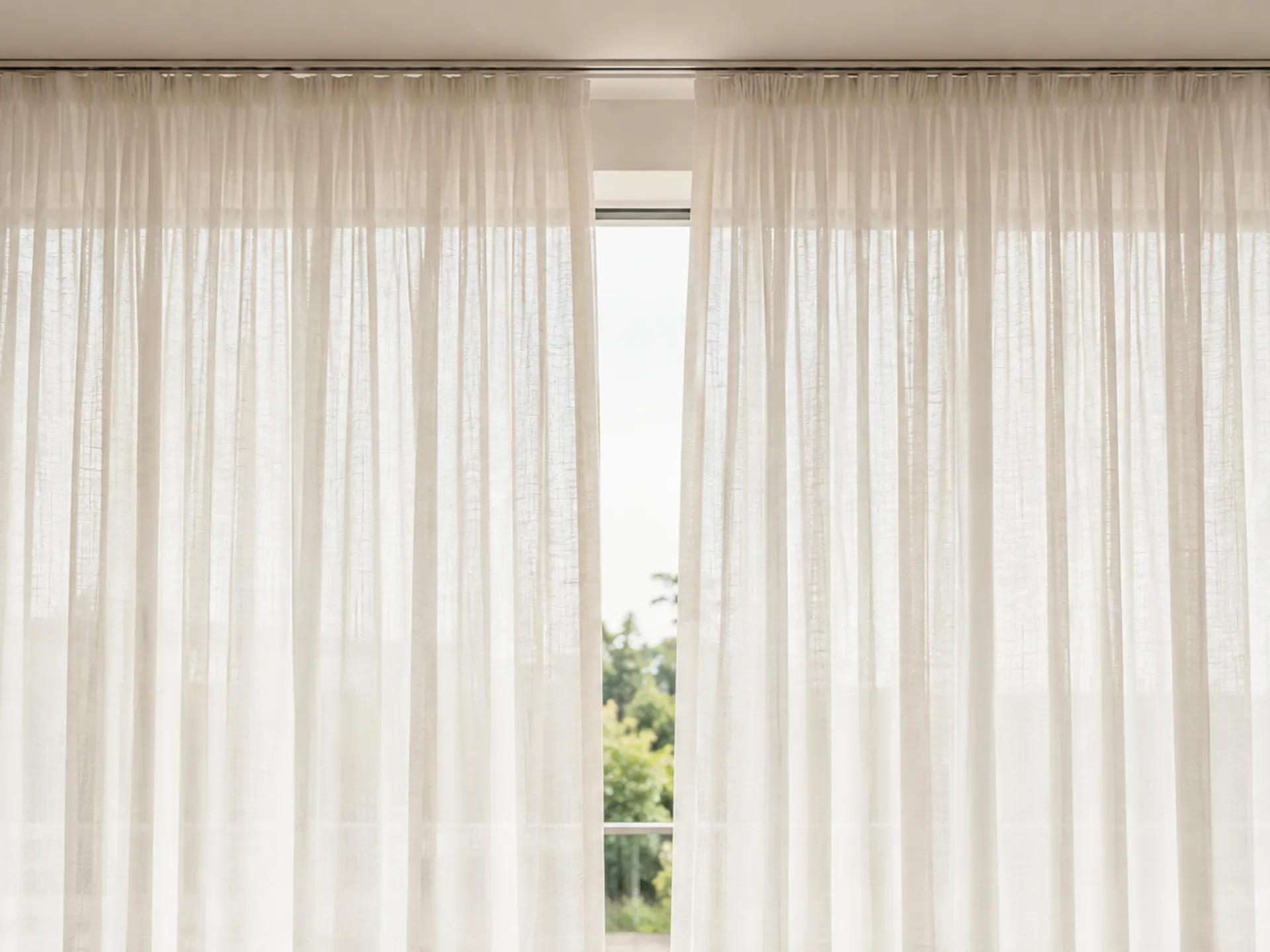
| Two-layer curtain, sheer plus opaque | As dark as the opaque curtain alone, with more choice of light | The same as a single opaque curtain | Rooms that want soft daylight and privacy during the day |
Two layers of curtain don't make the room any darker than the opaque layer on its own. The benefit is in the daytime: close just the sheer for soft light without people seeing in clearly, then draw the opaque layer at night. Pairing a roller blind with a curtain is the most direct fix for edge leaks, because each layer covers the other's gaps. Whether two layers will fit depends on the space above the glass and the ceiling structure, which has to be looked at on site — message us and ask.
| Product | Starting price | Minimum per unit | Motor per unit | Installation per unit |
|---|---|---|---|---|
| Motorized Roller Blind | 690 THB/sq yd | 1.5 sq yd | 5,000 ฿ | 200-2,500 THB per unit depending on size |
| Curtain | 350 THB/yd | — | — | 200 THB per unit · under 10 units is a flat 2,000 THB · free over 20,000 THB |
| Motorized Curtain Track | 5,900 THB/set | — | — | 200 THB per unit · under 10 units is a flat 2,000 THB · free over 20,000 THB |
Excludes VAT · the final price depends on fabric grade and how many units
Motorized blinds in a bedroom: are they noisy, and do you really use them?
The bedroom is where a motor earns its keep, because it's the one room where you open and close the blinds from bed. A motorized blind runs from a remote, a phone app or a wall switch; the app is Tuya, and no separate hub box is needed. Close it from the bedside at night, open it in the morning without getting up. A blind that's easy to close is a blind that gets closed fully every night — which matters to darkness as much as the fabric does.
On noise, the shop's answer is: quieter than an electric fan. On power, a wired motor needs a socket near the headrail. If there isn't one, an electrician has to add it first — we don't do wiring — or you can choose a rechargeable battery motor instead. Both a motorized roller blind and a motorized curtain track work in a bedroom. If you're still weighing a motor against a manual blind, motorized vs manual blinds sets them side by side.
Is the motor noisy in a bedroom?
Quieter than an electric fan.
Does bedroom fabric have to be dark to block light?
No. Opacity comes from how the fabric is constructed, not from its colour. A pale blackout stops light through the cloth just as a dark one does. Choose the colour for the room and treat the light level as a separate question.
If the power goes out at night, does a motorized blind get stuck?
It doesn't get stuck — you can pull it by hand, though it feels a little stiffer than a manual blind.
There's no socket near the window in my bedroom — can I still have a motorized blind?
Yes, in one of two ways: have an electrician run power to the headrail first (we don't do wiring), or use a rechargeable battery motor, which takes about 2 hours to charge and runs 4-6 months per charge.
My bedroom has several windows — do I need a remote for each?
No — one remote can drive several blinds together.
Want the numbers for your own windows?
Send rough sizes first — no need to measure precisely. We'll work out a price, then arrange the real measure.