Guides
How to measure your own windows before asking for a price
You don't need fitter-level precision — we measure properly before anything is made. But a decent measurement now means the price we send back is far closer to the real one.
Two reasons to measure first. One, you get a ballpark price to think about without booking anyone into your home. Two, you find out how many windows you actually have and how much they vary — which makes the conversation faster with any shop, not just us.
Two things to have ready
- A steel tape measure, not a fabric one. Fabric tapes stretch and sag, and that's centimetres of error.
- Paper and pen. Write each window down as you go. By the fourth window, memory stops being reliable.
Decide first: inside the frame, or outside it
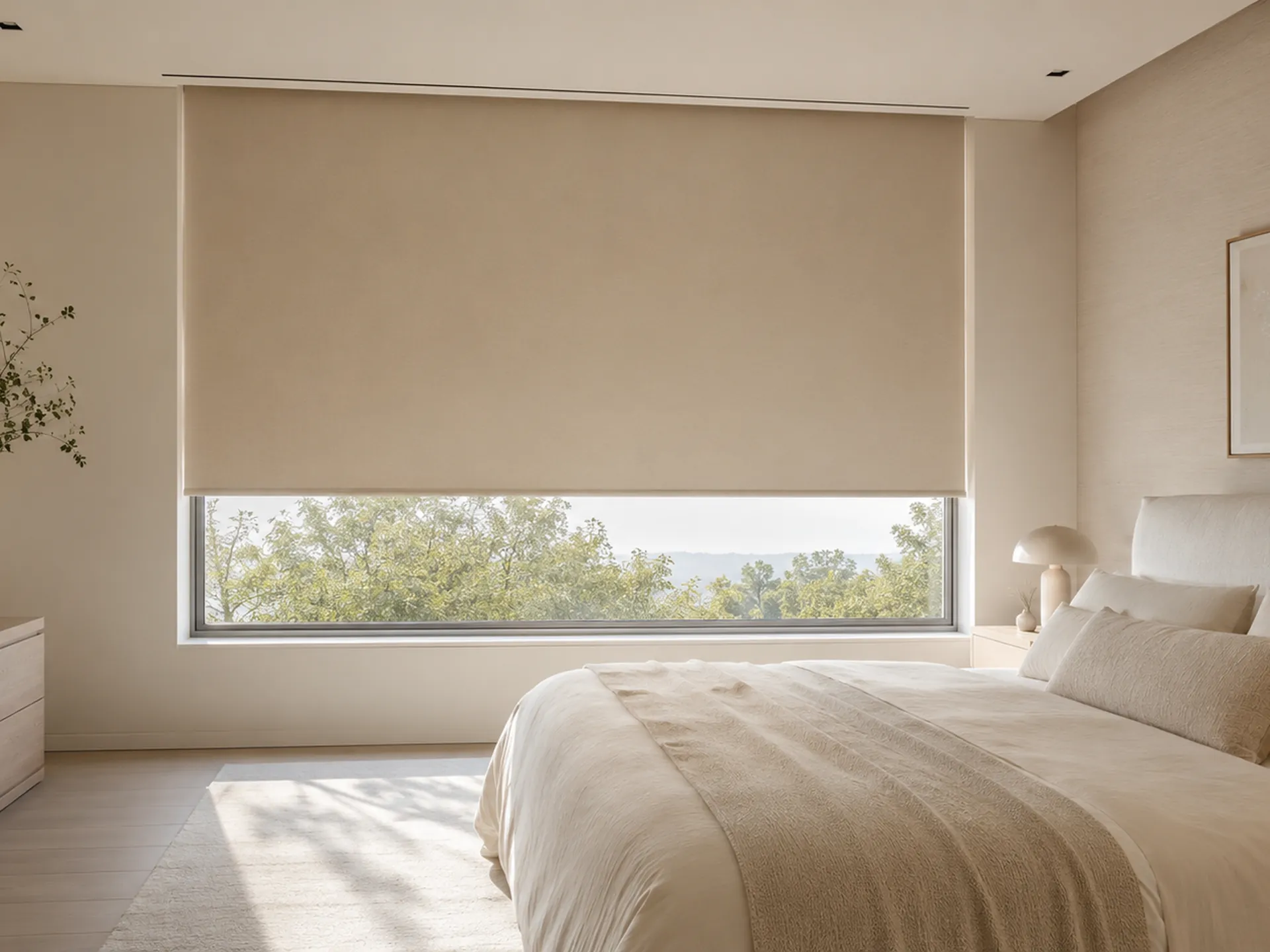
Decide this first, because it changes how you measure. Inside mount sits within the window reveal — neat and flush, but a thin light gap at each side is unavoidable. Outside mount goes on the wall above the window, with the fabric overlapping the frame on both sides. It blocks light better and makes the window look bigger.
If the goal is a dark bedroom, go outside mount and let the fabric run past the frame on both sides. A few centimetres each side is the usual convention; exactly how much for your window is something the fitter works out on site.
Step by step
- Measure the width in three places — top, middle and bottom of the opening. Older homes and uneven plaster routinely give three different numbers.
- Inside mount: use the narrowest. The blind has to clear the tightest point. Outside mount: use the widest, then add your overlap.
- Measure the height in three places — left, centre, right, on the same principle.
- Always write it width × height, in that order, every time.
- Stick to centimetres. Don't mix inches in.
- Name each window — big bedroom, small bedroom, living room left. It saves confusion later.
The five most common mistakes
- Swapping width and height. The most common of all, and it throws the price off immediately.
- Measuring the old curtain instead of the window. The previous one may have been hung wrong or been too short from day one. Always measure the window.
- Forgetting what sticks out — handles, a proud frame, a latch. Any of these can foul the blind, so note them.
- Measuring one point only. Even a window that looks perfectly square is often out by a centimetre or two.
- Rounding to a tidy number. If it's 178, write 178, not 180. Adding allowances is the fitter's job, not yours.
The sizes we make, per unit
| Product | Width (cm) | Height (cm) |
|---|---|---|
| Motorized Roller Blind | 50+ | 100+ |
| Wooden Blind | up to 250 | up to 300 |
| Vertical Blind | — | up to 320 |
| Room Divider | — | up to 360 |
| Curtain | — | up to 1000 |
Larger openings are still possible — they are simply split into several units. Message us.
Bigger than the table? Still doable — it's split into several units side by side, which leaves a seam between them. Tell us in advance whether a seam is acceptable and we'll plan the split around that.
Sending us the sizes
Enter them one window at a time in the window size tool. It builds a single list with a reference code, so you don't retype sizes in chat and we see every window from your first message. We price it, and if you want to go ahead, we book the proper measure before anything is made.
What if a measurement turns out wrong?
If the error is ours, we fix it at our cost.
What should be ready before you measure?
The room needs to be fully finished — the measurements have to be the final ones.
What does the site measure cost?
500-1,000 THB in Bangkok and the metro area, credited back in full when you order. Outside that it starts at 3,500 THB depending on distance, and is not credited back.
Want the numbers for your own windows?
Send rough sizes first — no need to measure precisely. We'll work out a price, then arrange the real measure.