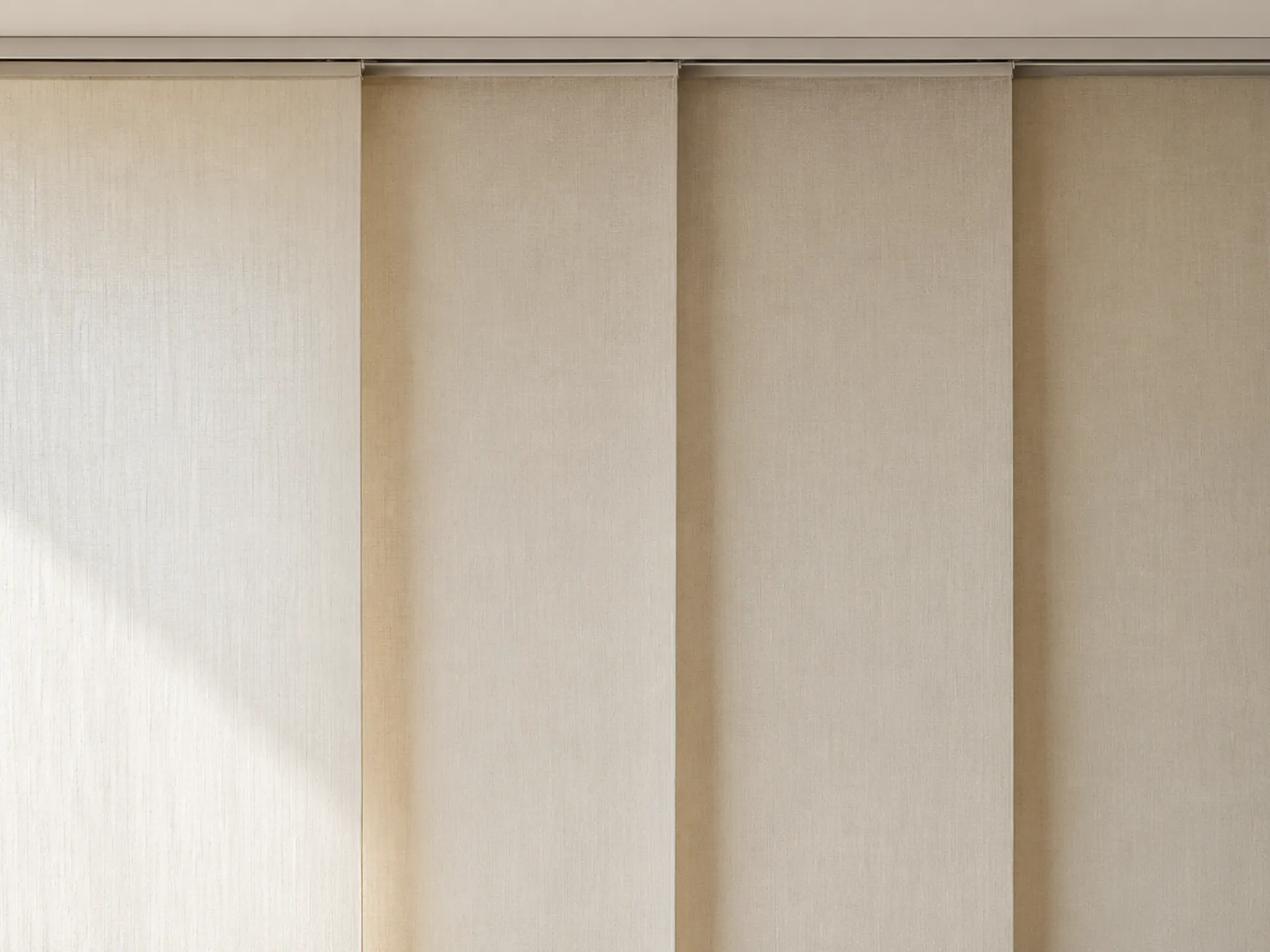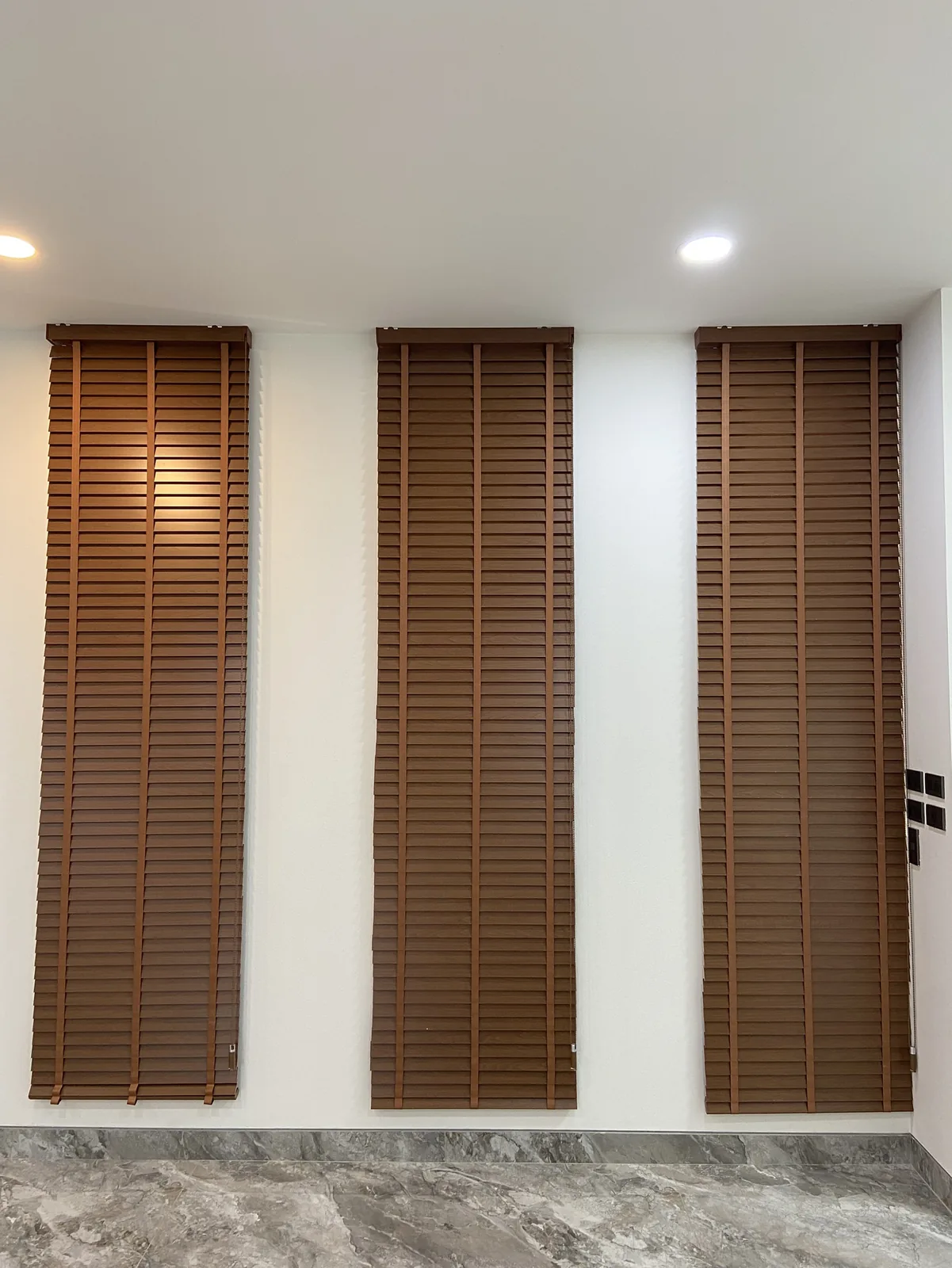
Close the slats flat, then dust the whole face at once
Don't do it slat by slat. Tilt them fully closed so they form one flat surface, sweep top to bottom with a microfibre cloth or a dusting mitt, then tilt the other way and repeat.

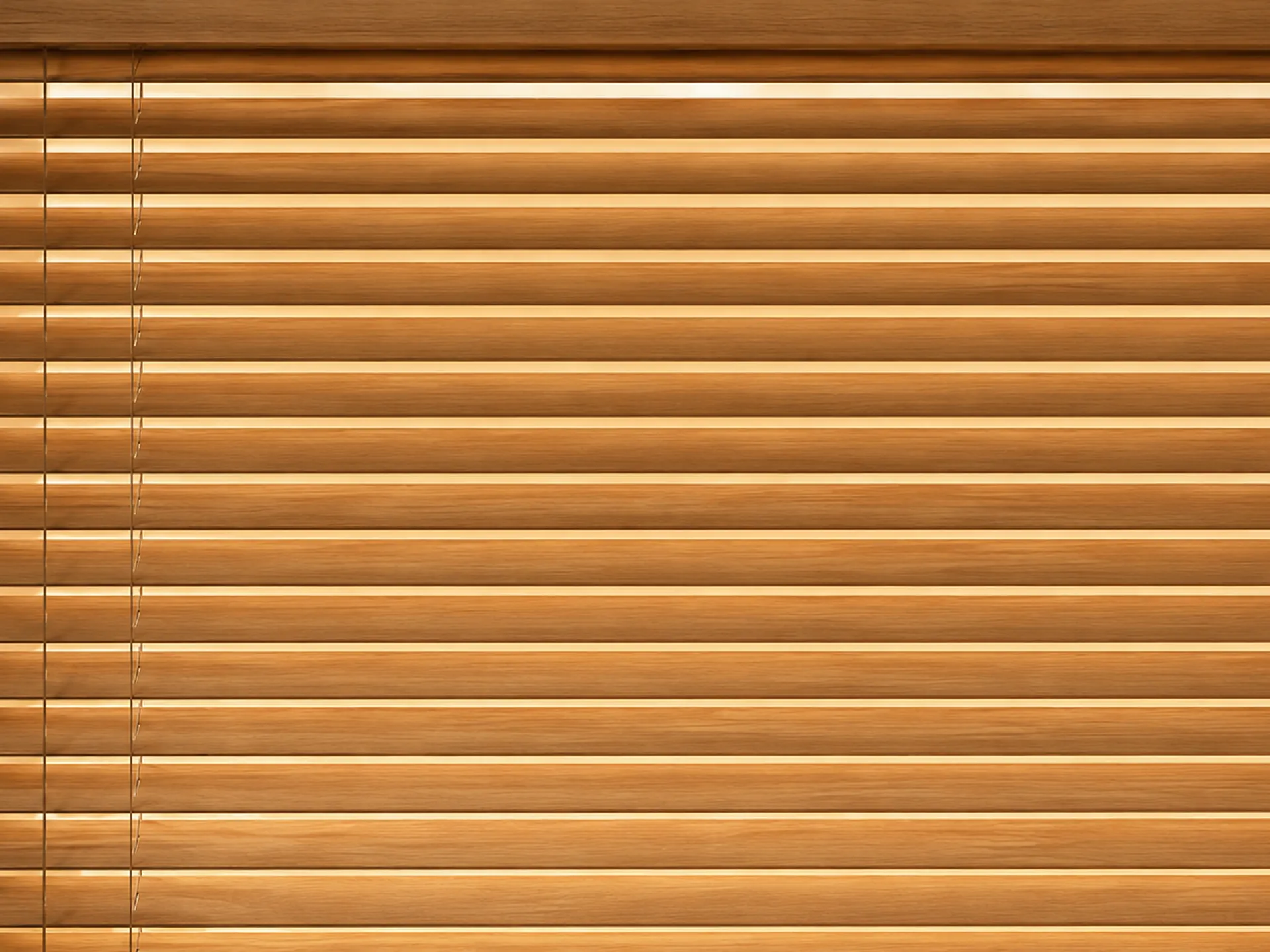 Manual
Wooden Blind
Tilt the slats to aim the light exactly where you want it. Real wood warmth, humidity resistant.
Excludes VAT · the final price depends on fabric grade and how many units
Wooden Blind
A wooden blind is a stack of horizontal slats strung on cords, and it moves two ways: tilt the slats to steer the light, or lift the whole stack up to the headrail. That tilt is the main reason people choose a blind over fabric.
It gives you something curtains can't — you can kill the light that's hitting you in the eye without shutting the window down completely. A home office with afternoon glare on the screen is the clearest case: a small tilt fixes it, the room stays bright, and you can still see out.
Basswood is a light timber, so a big blind doesn't end up too heavy for its own headrail, and it has the warmth of real wood that aluminium never quite fakes. The trade-off is that wood asks for a bit more care than metal or plastic — especially around water.
The number beside each fabric is roughly how much light it blocks.
Jobs that used this product — open one for the photos and clips from site.
The limits up front, so nothing is a surprise once it's on the wall.
Work through these in order and the choice narrows fast.
Ours come in three slat widths: 25, 35 and 50 mm. Wider slats show more of the view when open and feel airier — good on big windows. Narrower slats read as finer and neater, and suit small windows better. Let the window size lead, then your taste.
Most people hold the sample against the wall, then wonder why it looks off — the thing it actually sits next to is the window frame and the door trim. If the house already has woodwork, match that first.
Inside the reveal shows off the frame and looks neat, but the reveal has to be deep enough to swallow the headrail. Too shallow and it mounts outside — covering the frame and taking a little wall on each side.
A window facing the afternoon sun takes hours of heat every day. Espresso and walnut look superb but hold more of it. On a wall that bakes all afternoon, put a lighter tone on the shortlist too.
A small thing that gets forgotten. Ours run on a chain, and if it lands on the same side as a wardrobe or an awkward corner you'll be reaching over something every single time. Settle left or right at the measure.
Wooden blinds are priced by the square yard of each blind, so the cost follows the real area of the window rather than a flat price per unit — and there's a minimum per unit, with anything smaller charged at that minimum.
The starting price for this category is higher than fabric or roller blinds, because it's real timber that has to be sorted, finished and strung slat by slat. The starting figures and installation cost are in the table below; the real number is confirmed after the on-site measure.
Don't do it slat by slat. Tilt them fully closed so they form one flat surface, sweep top to bottom with a microfibre cloth or a dusting mitt, then tilt the other way and repeat.
Wood and standing water don't get along. Wipe a mark with a well-wrung cloth and follow it straight away with a dry one. Skip alcohol-based cleaners and polishes that leave a film — they streak the finish.
What fails on a blind is almost never the slats — it's the chain and the mechanism at the top. Pull in line with the blind, never at an angle or in jerks, and if it suddenly feels stiff, stop rather than pulling harder.
Leaving it down in hard sun every day for years fades the timber unevenly between the exposed part and the shaded part. Lifting it on days nobody's in the room keeps the colour more even.
We suggestWooden blind
Tilt the slats to kill screen glare without shutting the window.
FAQ
500-1,000 THB in Bangkok and the metro area, credited back in full when you order. Outside that it starts at 3,500 THB depending on distance and is not credited back.
The room needs to be fully finished — the measurements have to be the final ones.
7-14 days, depending on how many units.
If the error is ours, we fix it at our cost.
Just let the building management know in advance that a fitter is coming.
We don't take cleaning or repair work — not on curtains bought here, and not on curtains bought elsewhere. If it's something covered by the warranty (motor 6 years, installation 1 year, wooden blind slats 1 year), message us as usual.
Normal. The slats have to overlap loosely enough to rotate, so there's always a thin line of light along each one, on any brand at any price. If you need a genuinely dark room, look at a blackout roller instead.
Yes, it can be ordered motorized. The motor is 25,000 THB per unit, charged separately from the blind and not part of the per-square-yard price above. That is far more than a roller blind motor because the mechanism has to both tilt the slats and lift the whole stack, rather than simply winding one sheet of fabric. For a window you can comfortably reach, manual is far better value; motorizing makes sense on the ones you genuinely cannot reach.
Three things: we warrant the slats for one year, the hardware inside the headrail is solid, and it operates on a chain system rather than cords. None of that shows up on a quotation — it shows up a few years into using it.
It depends how wet. A bathroom with steam but no direct splashing and decent ventilation is usually fine. A window inside the wet zone, taking spray directly, will eventually swell and warp the timber.
Not quite what you pictured? These are the closest alternatives.
Guides that cover this product in full — no need to message us to find out.
Same fabric, same look — the only difference is whether you pull it or press a button. So the real question isn't which is better, it's which windows are worth paying a motor for.
These two are nearly three times apart in price, and people still pick by looks alone — when in fact they solve different problems.
Most people pick fabric by colour, when the thing that decides whether the room works is how much light it stops — and the same colour comes in several levels.
You don't need fitter-level precision — we measure properly before anything is made. But a decent measurement now means the price we send back is far closer to the real one.
The hard part is not finding out who is more expensive. It is that no two quotes count the same things, so they cannot be laid side by side. These seven questions make them comparable.
Wooden blinds are priced by the area of each blind in square yards, with a minimum per unit, and a separate motor charge if you want one motorized. Here's the pricing one part at a time, followed by the care you can do yourself at home.
A motorized blind has one part a manual blind doesn't: the motor. So the warranty question always follows. Here are our warranty figures part by part, what isn't covered, and what to do when a blind stops moving.
An office asks different things of a blind than a home does. Darkness is rarely the point. Screen glare, long runs of glass and low-effort upkeep are. This guide goes room by room through vertical blinds, sunscreen rollers and wooden blinds, then covers what the person signing it off usually asks: price, fitting times and tax invoices.
Service area
Pick your area to see what homes and condos there usually run into, and what tends to suit them.