Dust both faces of every panel
The side facing into the room is in view daily so it doesn't get forgotten. The backs — the faces that press together when stacked — do. Run a vacuum brush head down both sides a few times a year.

 Manual
Room Divider
Divide a space without building a wall. Slides away when you don't need it.
Excludes VAT · the final price depends on fabric grade and how many units
Room Divider
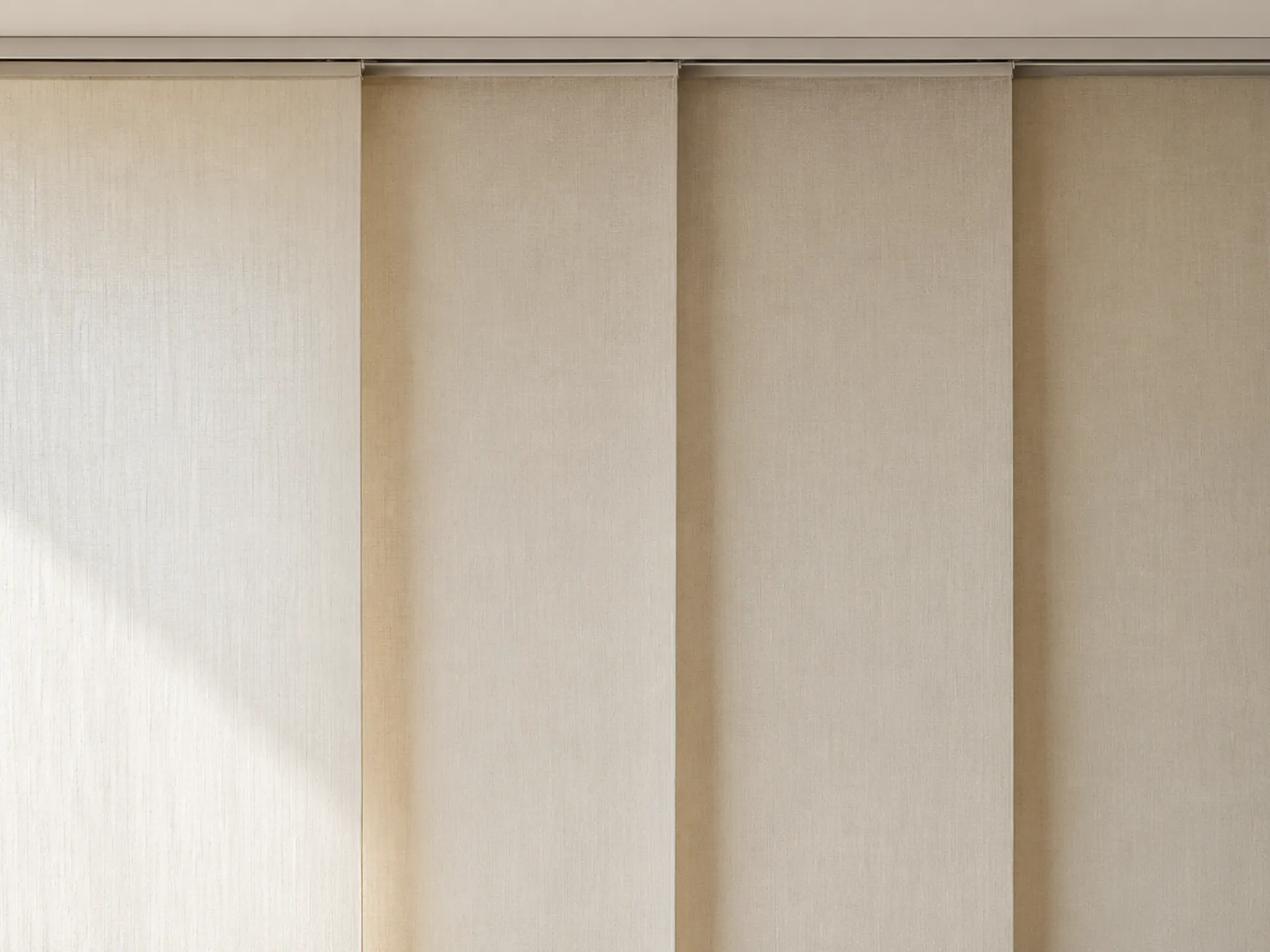
A room divider is a set of large flat panels hanging on a multi-channel track. Each panel slides on its own, so they stack behind one another at one end when you don't need them and spread out into a continuous wall when you do.
Unlike a curtain, each panel is flat and taut with no folds, so it reads as architecture rather than as soft furnishing. Studio condos that want to separate the sleeping corner from the living area without building anything usually land here — it comes out again, and the landlord doesn't mind.
One thing to be clear about from the start: this divides a space visually, not acoustically. Sound passes, smells pass, and air moves over the top and under the bottom. If you're expecting a genuinely closed room, a panel divider will disappoint you.
The number beside each fabric is roughly how much light it blocks.
The limits up front, so nothing is a surprise once it's on the wall.
Work through these in order and the choice narrows fast.
The panel count decides how thick the stack is when parked. More panels cover more but pile up deeper. If one end of the run is a walkway or a door, send the stack the other way — or split it to both ends.
Screening a sleeping corner? A solid panel feels much more like a room. Screening a desk or some shelving? Something slightly more open keeps the space from feeling boxed in and still borrows light from the other side.
Ceiling-fixed looks the most like a real wall, because the panels run floor to ceiling — but the ceiling has to have something solid to fix into. Wall-fixed only works where you're covering a window or screening part of a room.
Panels that drag get dirty at the hem and catch as they slide, so always leave a little clearance. It shows more than on curtains because the edge is a straight line — agree the gap at the measure and keep it identical across every panel.
A fully closed screen photographs beautifully, but if you cross it often, sliding a panel every time gets old fast. Plan one panel to act as the door and make sure it's easy to move from both sides.
Panel dividers are priced by the square yard of total panel area, with a minimum per unit like the other square-yard categories. The bigger the space you're closing off, the more panels it takes and the higher the area-based price.
The starting figures, the drops we make and the installation cost are in the box below. What can't be judged from photographs is whether the ceiling can carry the track — which is exactly why this kind of job gets looked at on site first.
The side facing into the room is in view daily so it doesn't get forgotten. The backs — the faces that press together when stacked — do. Run a vacuum brush head down both sides a few times a year.
Panels are cut and weighted to hang exactly taut. Wash one and even slight shrinkage leaves it rippling, which shows immediately on a flat surface. A damp sponge on the mark itself is far safer.
Panels are wider and heavier than a curtain, so the carriers work harder. If it starts to grumble or drag, vacuum the track first — don't spray lubricant into it, which just collects dust into a sticky film.
Push from the side edge, not the middle — pushing the centre twists the panel and loads one carrier far more than the other. And never hang clothes or anything else off a panel.
We suggestRoom divider
Separate sleeping and living space without building a wall.
FAQ
The room needs to be fully finished — the measurements have to be the final ones.
7-14 days, depending on how many units.
Just let the building management know in advance that a fitter is coming.
500-1,000 THB in Bangkok and the metro area, credited back in full when you order. Outside that it starts at 3,500 THB depending on distance and is not credited back.
If the error is ours, we fix it at our cost.
No. Fabric panels screen the view and make a space feel divided, but they don't seal to the floor and ceiling the way a wall does, so sound passes almost freely. If blocking noise is the main goal, you need an actual wall.
Yes, but it needs backing beams — plasterboard on its own won't hold several panels over time. The beams are charged by the length required (the figure is in the list of extra costs), and how much is needed is settled at the on-site measure.
Not quite what you pictured? These are the closest alternatives.
Want softness, folds, and some help with echo? Curtains do more for that than flat panels.
If the real job is covering glass and steering light rather than dividing space, verticals fit better.
For blacking out a window and running it from a remote, a motorized roller is a different job entirely.
Guides that cover this product in full — no need to message us to find out.
A condo differs from a house in two ways that matter here: you don't own everything you might want to drill into, and the glass is usually larger than the room can comfortably take.
A room divider splits a space without building a wall and slides out of the way when you don't need it. It divides what you see, though, and it is not a wall. This guide gives both sides: where it works, where it will disappoint, how it's priced and what to measure before asking for a quote.
Service area
Pick your area to see what homes and condos there usually run into, and what tends to suit them.