Guides
Room dividers: what they are, where they work, how they're priced and their limits
A room divider splits a space without building a wall and slides out of the way when you don't need it. It divides what you see, though, and it is not a wall. This guide gives both sides: where it works, where it will disappoint, how it's priced and what to measure before asking for a quote.
People searching for a room divider usually already have a problem in mind: a studio condo where the bed is the first thing you see from the door, a room the air-conditioning can't quite cool, or an office that wants a meeting corner without paying for a wall. A divider answers some of those and not others. Better to know which before ordering than after it's up.
What is a room divider, and how is it different from a wall?
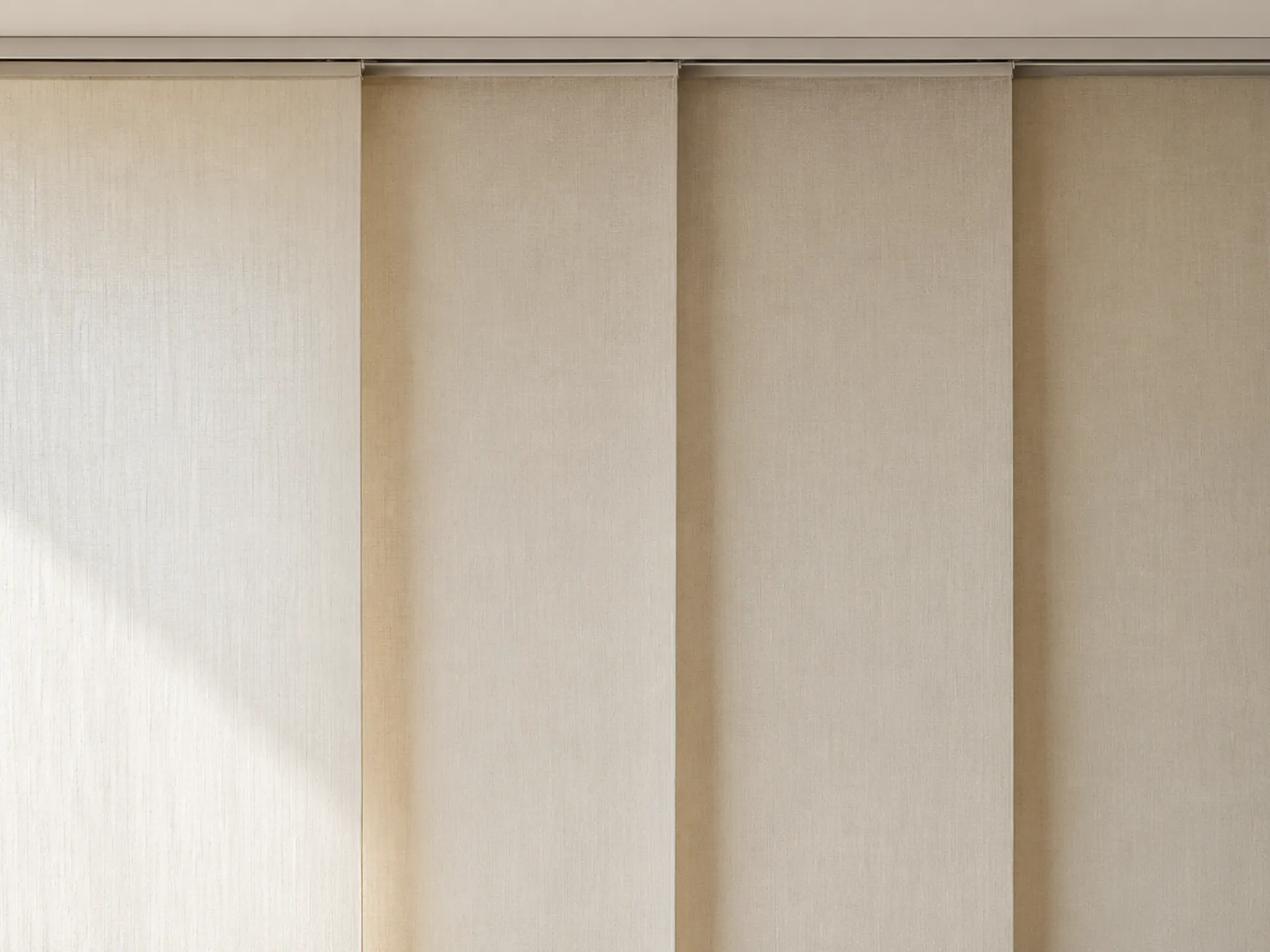
Our room divider is a set of large flat fabric panels hanging on a multi-channel track. Each panel slides on its own, by hand. When you don't need them they stack behind one another at one end, and when you want the space split they spread out into a continuous line. Each panel is flat and taut with no folds, so it looks closer to a wall than to a curtain.
- It doesn't block sound. Fabric panels don't seal to the floor and ceiling the way a wall does, so sound passes almost freely.
- It doesn't stop smells or seal the air. Air still moves over the top and under the bottom of the panels.
- It doesn't lock. If you need a room that closes for real privacy, that takes an actual wall and door.
- The track needs something solid to fix into. Several panels together weigh a fair amount, and a ceiling that can't take a fixing needs backing first.
- It needs a clear path along the whole run. Furniture in the line of the track stops the panels sliding.
Where does a room divider work well in a condo?
- Studio condos: separating the bed from the living area without building a wall. Stack it away by day to open the room up, and draw it across at night or when guests come.
- A home work corner: shut it out of sight after hours, or use it as a plain backdrop on a video call.
- Open wardrobes and shelving: cover the front so the room looks tidy.
- Open-plan offices: a temporary meeting corner without paying for glass partitions, as long as everyone understands voices still carry.
- Wide glass: in place of curtains or a roller, when you want the flat panel look.
For a condo, do two things first. One: let the building management know in advance that a fitter is coming. Two: if you rent, ask the owner, because fixing the track means drilling into the ceiling or wall. The upside is that it comes out again when you leave, unlike a built wall. The rest of the condo questions are in choosing curtains for a condo.
What should you use to keep air-con in one zone, and how far does a divider help?
The general principle: the smaller the space an air-conditioner has to cool, the less work it does, and anything standing between two zones slows the air on each side from mixing. A divider helps in that sense, but it doesn't seal. Cool air still moves over the top and under the bottom of the panels, so don't expect what a wall or a sliding door would give. If the main goal is truly to hold the cold in one zone, the more direct answer is a lightweight partition or a door that shuts properly. If the goal is to divide the space, with some help on the air-con as a bonus, a panel divider or a curtain on a track is the route that comes out again and needs no building work.
How much is a room divider, and how is it priced?
| Product | Starting price | Minimum per unit | Installation per unit |
|---|---|---|---|
| Room Divider | 890 THB/sq yd | 1.5 sq yd | 200 THB per unit · under 10 units is a flat 2,000 THB · free over 20,000 THB |
Excludes VAT · the final price depends on fabric grade and how many units
A room divider is priced by the square yard of total panel area, with a minimum per unit. A set smaller than the minimum is charged at the minimum. The wider and taller the line you're closing off, the more panel area there is, and the price follows the real area. Fitting follows the shop's standard formula shown in the table, and the height we make is in the next table. Panels longer than that swing and lose their shape. Every price is before VAT, and the real figure is confirmed in the written quote after a site visit, because the one thing photographs can't show is whether the ceiling can carry the track.
| Product | Width (cm) | Height (cm) |
|---|---|---|
| Room Divider | — | up to 360 |
Larger openings are still possible — they are simply split into several units. Message us.
- Fixing the track into a plasterboard ceiling: possible, but it needs backing beams first, because plasterboard on its own won't hold several panels over time. That is 550 THB per metre, and how much is needed is settled at the on-site measure.
- Ceilings high enough to need scaffolding: 500 THB per level.
- Something has to come down first: taking down old curtains is 200 THB per unit.
- The on-site measure: 500-1,000 THB in Bangkok and the metro area, credited back in full when you order. Outside that it starts at 3,500 THB and is not credited back.
- Fitting times: fitting after 17:30 costs extra. Weekends are at no extra charge.
Room divider or a curtain on a track: how do they compare for splitting a room?
| Room divider | Curtain on a track | |
|---|---|---|
| Look | Flat, taut panels with straight edges, close to a wall | Fabric falling in folds, softer and warmer |
| When open | Panels stack behind one another at the end. How deep depends on the panel count | Fabric gathers into a stack at the end of the track |
| Walking through | Slide one panel like a door | Part the fabric at the split |
| Sound | Doesn't block it | Doesn't block it either, though heavy fabric takes some echo out of a bare room |
| Height | Has a maximum drop, see the table above | Makes a greater drop, see the product page |
| Pricing | Square yards of panel area, with a minimum per unit | By the yard, with the price set by fabric grade |
A simple way to choose: if you want the divide to read as part of the room, straight, flat and without folds, look at the panel divider. If you want softness, or the room is bare enough to echo, or the ceiling is higher than panels can go, look at curtains, which are priced a different way, explained in how curtains are priced by the yard. Both leave a gap at the floor and the ceiling. Neither closes the way a wall does.
What do you need to measure before ordering a room divider?
- The width of the line you want to close: wall to wall, or from where it should start to where it should end.
- Floor to ceiling height: taken at several points along the run, since floors and ceilings are not always level. Panels have straight edges, so an uneven gap shows more than it would on a curtain.
- What the ceiling is: masonry, plasterboard, or with framing already there. Send photos. This one gets checked again on site.
- Which end the panels park at: if one end is a door or a walkway, send them the other way, or split them to both ends.
- Where you'll walk through: plan one panel to act as the door, easy to slide from both sides.
- Anything in the line of the track: furniture, a ceiling beam, light fittings, sprinkler heads or an air-conditioner in the way.
Send rough sizes and photos on LINE first. They don't have to be exact. For measuring without mistakes, see how to measure your own windows. Before the real measure the room needs to be fully finished, because the measurements have to be the final ones. We then send a written quote within a day, and the price holds for 7 days. From confirming to fitted takes 7-14 days, depending on how many units.
How much does a room divider cost?
From 890 THB per square yard, with a minimum of 1.5 square yards per unit, before VAT. Fitting is 200 THB per unit, a flat 2,000 THB for under 10 units, and free over 20,000 THB. The real price depends on the total panel area and the material you choose.
Does a room divider block sound?
No. Fabric panels screen the view and make a space feel divided, but they don't seal to the floor and ceiling the way a wall does, so sound passes almost freely. If blocking noise is the main goal, you need an actual wall.
What's the tallest room divider you make?
Up to 360 cm high. Panels longer than that swing and lose their shape. If your ceiling is higher, message us on LINE first, as curtains may be the better route.
In a condo, can the track fix straight into a plasterboard ceiling?
Yes, but it needs backing beams, because plasterboard on its own won't hold several panels over time. The beams are 550 THB per metre, and how much is needed is settled at the on-site measure. Remember to tell the building management in advance that a fitter is coming.
Can a room divider keep the air-conditioning in one area?
To a degree, because it slows the air on each side from mixing. It doesn't seal, though. Air still moves over the top and under the bottom of the panels, so we have no figure for how much it helps. To genuinely hold the cold in, you need a wall or a door that shuts properly.
Want the numbers for your own windows?
Send rough sizes first — no need to measure precisely. We'll work out a price, then arrange the real measure.