Guides
Pleated or wave curtains: how they differ and which one suits your room
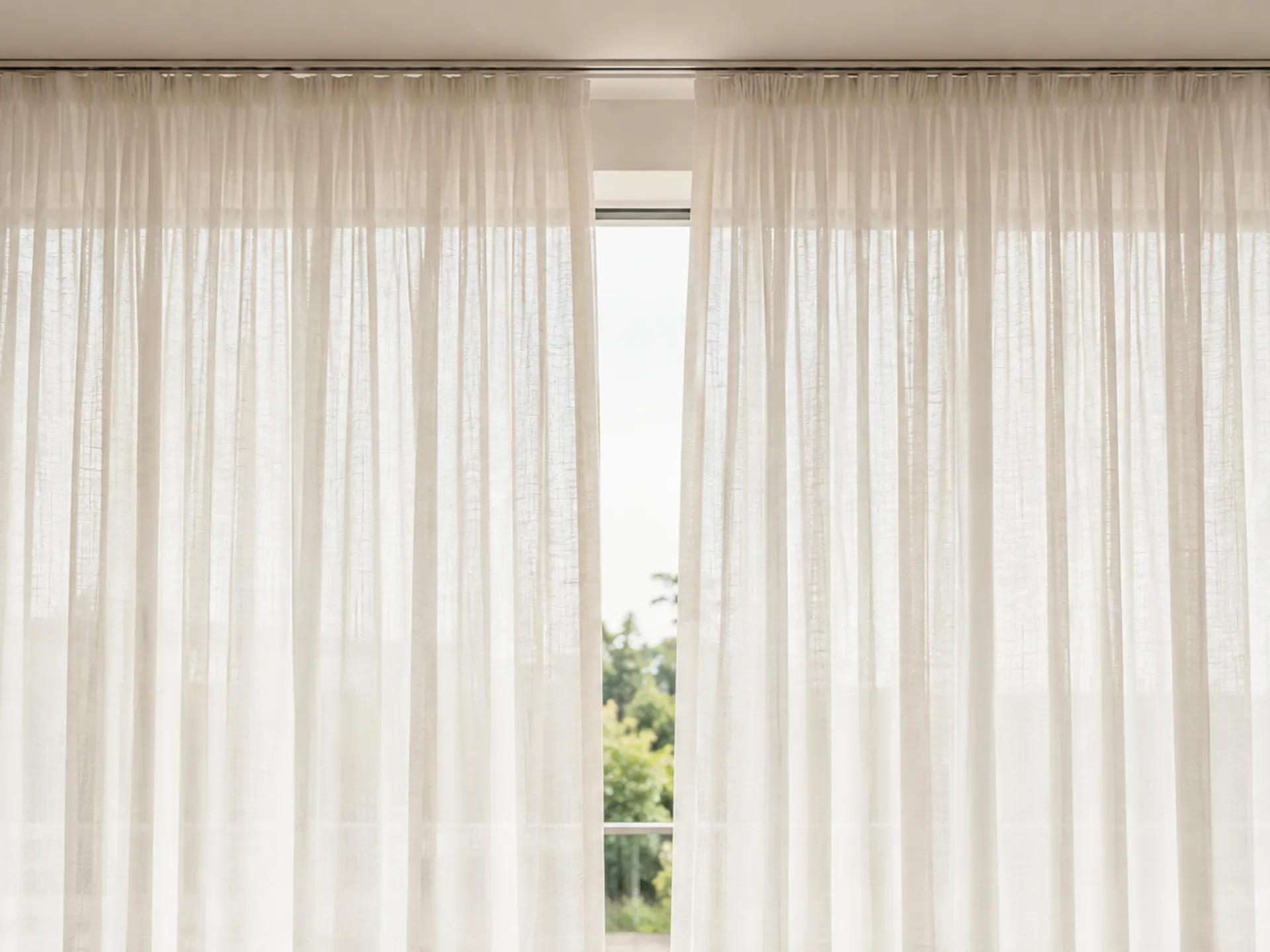
The same fabric in the same colour gives a room two different moods as a pleated curtain and as a wave curtain. The whole difference is in the heading and the track, not in the cloth.
Most people choose colour and cloth first and only then run into the question of pleated or wave. It really ought to come first, because the style decides which track is used, which fabrics will look right, and where the curtain sits when it's open.
How do pleated and wave curtains differ?
| Pleated | Wave | |
|---|---|---|
| Look | Folds gathered into groups at the top, relaxing into looser folds below. Classic, formal. | Even curves running from the top to the hem. Clean, contemporary. |
| How the heading is made | The pleats are sewn permanently into the top of the fabric, which then hooks onto the track. | The top stays flat with a tape sewn to the back. Evenly spaced carriers on the track force it into ripples. |
| Track | A pleated-curtain track | A dedicated wave-curtain track |
| Fabric that suits it | Almost anything, heavy cloth included | Fabric that drapes well. Very stiff or very thick cloth tends not to ripple nicely. |
| When open | A thicker stack, because the pleats pile up at the top | Folds back along its own ripples into a flatter, tidier stack |
| Clearance from wall or glass | Needs less | Needs more, because the ripple swings both in front of and behind the track |
What is a wave curtain, and why are the ripples so even?
A wave curtain — some shops call it taped wave or S-wave — has no pleats in the heading at all. The top is as flat as a plain sheet. The ripple comes from the track: its carriers are linked at an equal spacing, and because the fabric between them is wider than that spacing, it has to curve forward, then back, all the way along. That is why every ripple matches and runs right down to the hem.
A pleated curtain works the other way round: the shape is set in the cloth. The pleats are sewn into the heading when the curtain is made, so they are crisp at the top and relax down the length. Pleated curtains carry more detail up top; wave curtains read as plain vertical lines the whole way.
Which one uses more fabric?
Both styles always use fabric wider than the window. Cut it to the exact width and the closed curtain pulls flat with no folds at all. How much wider depends on how close the pleats are or how deep the ripple is — tighter pleats or deeper ripples mean more cloth. As a rule a wave curtain uses no less than a pleated one, and often more. The real figure has to be worked out from the track width of each window, not guessed.
This feeds straight into the price, because curtains are charged by the yard of fabric — more cloth, more cost. The starting prices for curtains and for a motorized curtain track are in the table below, and how curtains are priced by the yard explains how the yardage is worked out.
| Product | Starting price | Minimum per unit | Installation per unit |
|---|---|---|---|
| Curtain | 350 THB/yd | — | 200 THB per unit · under 10 units is a flat 2,000 THB · free over 20,000 THB |
| Motorized Curtain Track | 5,900 THB/set | — | 200 THB per unit · under 10 units is a flat 2,000 THB · free over 20,000 THB |
Excludes VAT · the final price depends on fabric grade and how many units
How much room does each take up when open?
People tend not to think about this until fitting day. An open curtain doesn't disappear — it stacks at the end of the track. A pleated curtain stacks thicker because its pleats pile up at the top; a wave curtain folds back along its own ripples and sits flatter. Choose a deep ripple with a lot of fabric, though, and the stack grows with it. Either way, if you want the whole pane clear when the curtain is open, the track has to run past the window so the fabric can stack on the wall.
Then there is depth. A wave curtain's ripple swings both in front of and behind the track, so it needs enough space behind the cloth to clear the glass, a window handle or the edge of the frame. If your handles stick out or the recess is shallow, say so at the measure.
Which is better? Choosing by room and style
- Classic rooms with cornices or detailed furniture — pleated sits in more easily, since the heading is a detail in its own right.
- Plain, modern or minimal rooms, and full-height glass — wave gives steady vertical lines that don't compete with the rest of the room.
- Heavy, opaque or lined fabric — pleated handles weight better. For a wave curtain, look at a real sample first to see whether it drapes enough.
- Sheers and light fabric — either works. Wave with a sheer is a pairing you see a lot in condos.
- Little space behind the fabric — pleated needs less clearance from the wall.
- You want it tidy when open — wave has the edge, because the ripples fall back into place on their own.
Can pleated and wave curtains be motorized?
Both can. The spec sheet for the Novo N99 track motor lists it for pleated-curtain tracks and wave-curtain tracks, so the motor doesn't narrow your choice — pick the style you like first. Track details and the motor specs are on the motorized curtain track page.
A motorized track is priced per set by its length band, and the figure in the table above already includes the motor. Fabric is charged separately by the yard. If you can't decide on a style yet, we bring fabric samples to the on-site measure — once the cloth is in your hand it's obvious which ones drape well enough for a wave curtain. Fabric grades and the other styles are on the curtain page.
Can a wave curtain go on the pleated-curtain track I already have?
Generally not. A wave curtain gets its ripple from carriers on the track that are linked at an equal spacing, and an ordinary pleated-curtain track doesn't have those. Hang a flat-topped panel on one and it droops unevenly. Moving from pleated to wave means thinking about the track as well.
Is a wave curtain the same as an eyelet curtain?
No. An eyelet curtain has rings punched into the heading and threads onto a pole, so the folds are larger and you see the pole and the rings. A wave curtain hangs below a track with no rings showing, and its ripples are spaced by the carriers, so they are more even.
How do I operate a motorized pleated or wave curtain?
By remote control, a phone app or a wall switch. The app is Tuya, and no separate hub box is needed. In a power cut it doesn't get stuck — you can pull it by hand, though it feels a little stiffer than a manual curtain.
Do you wash curtains for customers?
We don't take cleaning or repair work — not on curtains bought here, and not on curtains bought elsewhere. The fabric itself isn't under warranty either; what is covered is the motor for 6 years, the installation for 1 year, and wooden blind slats for 1 year.
Where can I see real fabric before I settle on a style?
You're welcome to walk in. We're in Bang Kruai, Nonthaburi, open 10:00-17:30, and the full address is at the bottom of this page. If coming over isn't convenient, we bring the samples to you at the measure anyway.
Want the numbers for your own windows?
Send rough sizes first — no need to measure precisely. We'll work out a price, then arrange the real measure.